Navigating the Unpiggable: Integrity Management Strategies for Challenging Pipelines
Addressing the integrity challenges of pipelines that cannot be inspected by conventional inline inspection (ILI) tools requires a multi-faceted and often innovative approach. This article outlines practical strategies for managing the integrity of 'unpiggable' pipelines, focusing on risk assessment, alternative inspection methods, and proactive mitigation.

The Unpiggable Pipeline Conundrum
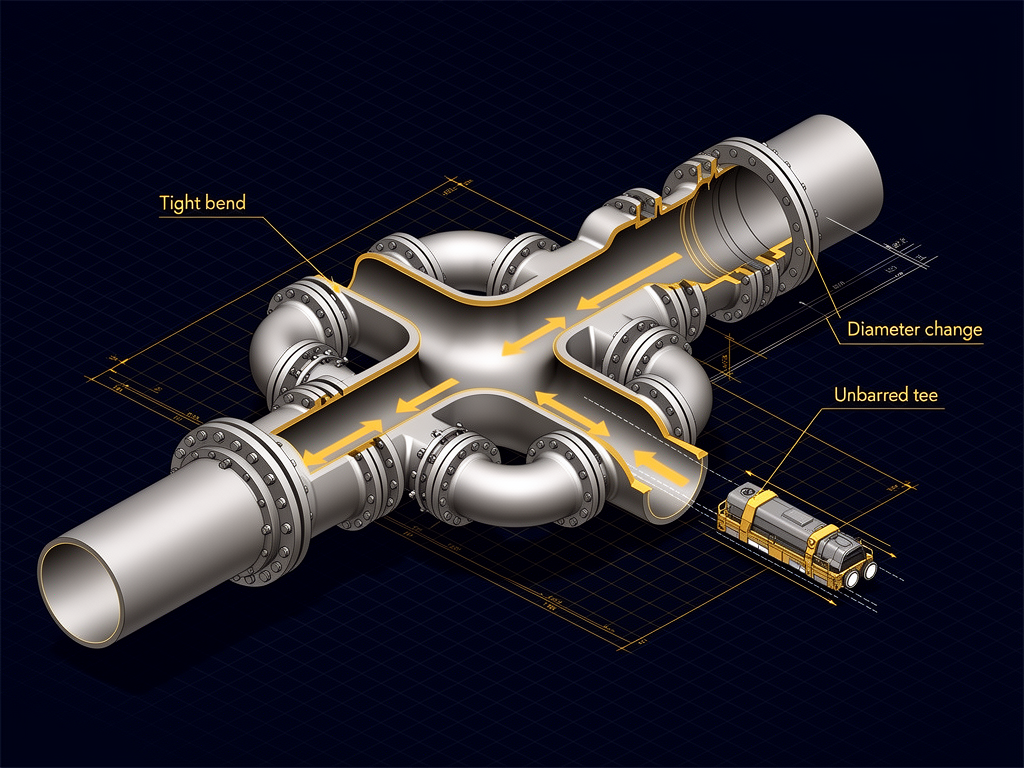
Many legacy pipelines, and some newer designs, present significant challenges to conventional inline inspection (ILI) tools. These 'unpiggable' pipelines may have features such as varying diameters, tight radius bends, unbarred tees, complex valve arrangements, multi-phase flow, or simply a lack of launching and receiving facilities. For pipeline operators, this presents a critical integrity management dilemma: how to assess and maintain the integrity of assets that cannot be directly inspected using the most reliable and comprehensive methods.
Ignoring these assets is not an option. Regulatory compliance, environmental protection, and public safety demand a robust integrity management program for all pipeline infrastructure. The key lies in developing a tailored strategy that combines various engineering principles, non-destructive testing (NDT) techniques, and robust risk assessment methodologies.
Understanding the 'Unpiggable' Classification
Before diving into solutions, it's crucial to thoroughly understand why a pipeline is deemed unpiggable. A detailed engineering review should be conducted to identify specific limitations. This might involve:
- Geometric Constraints: Analyzing pipe diameter variations, bend radii, ovality, and presence of unbarred tees or wye connections.
- Operational Constraints: Evaluating flow conditions (e.g., slugging, high solids content), pressure limitations, and temperature profiles that might preclude ILI tool passage or data acquisition.
- Access Constraints: Assessing the availability and suitability of existing launching/receiving facilities, or the feasibility of installing new ones.
- Mechanical Constraints: Identifying internal coatings, liners, or debris that could obstruct tool passage or damage the tool.
This diagnostic phase is critical for determining whether a pipeline is truly unpiggable or if minor modifications could enable ILI. Sometimes, a pipeline might be piggable with specialized or custom-built tools, which, while more expensive, could still be a viable option compared to long-term reliance on less comprehensive methods.
Risk-Based Integrity Assessment
For pipelines confirmed as unpiggable, a highly detailed risk-based integrity assessment becomes the cornerstone of the management strategy. This involves:
Data Gathering and Historical Review
Compile all available data, including design specifications, construction records, operating history (pressure cycles, flow rates, temperature excursions), maintenance records, previous inspection reports (if any, even visual or NDT at accessible points), and incident history (leaks, ruptures, repairs) on the pipeline and similar assets.
Threat Identification and Prioritization
Identify all credible integrity threats based on the pipeline's characteristics, operating environment, and transported product. Common threats include:
- Corrosion: Internal (due to product chemistry, water content, microbial activity) and external (due to soil conditions, coating damage).
- Mechanical Damage: Third-party interference, ground movement, manufacturing defects.
- Fatigue: Pressure cycling, vibration.
- Stress Corrosion Cracking (SCC): Both internal and external.
Prioritize these threats based on their likelihood and potential consequences, using a quantitative or semi-quantitative risk matrix. This guides the allocation of inspection and mitigation resources.
Consequence Assessment
Evaluate the potential impact of a failure, considering environmental damage, public safety, economic losses (downtime, repair costs, product loss), and reputational damage. High-consequence areas (HCAs) and environmentally sensitive areas (ESAs) must be identified and factored into the risk assessment.
Alternative Inspection and Monitoring Techniques
When ILI is not feasible, a suite of alternative techniques must be employed. The selection depends heavily on the identified threats and the specific characteristics of the pipeline segment.
Direct Assessment Methods
Direct assessment (DA) methodologies, such as External Corrosion Direct Assessment (ECDA), Internal Corrosion Direct Assessment (ICDA), and Stress Corrosion Cracking Direct Assessment (SCCDA), offer structured approaches to evaluate pipeline integrity in specific threat areas. These methods typically involve:
- Pre-assessment: Data gathering and historical review.
- Indirect Inspection: Using above-ground surveys (e.g., CIPS, DCVG for ECDA; acoustic monitoring for ICDA) to identify potential integrity anomalies.
- Direct Examination: Excavating and performing NDT (e.g., ultrasonic testing (UT), magnetic particle inspection (MPI), liquid penetrant inspection (LPI)) at locations identified in the indirect inspection phase.
- Post-assessment: Data analysis, remaining life assessment, and future inspection planning.
Non-Destructive Testing (NDT) at Exposed Sections
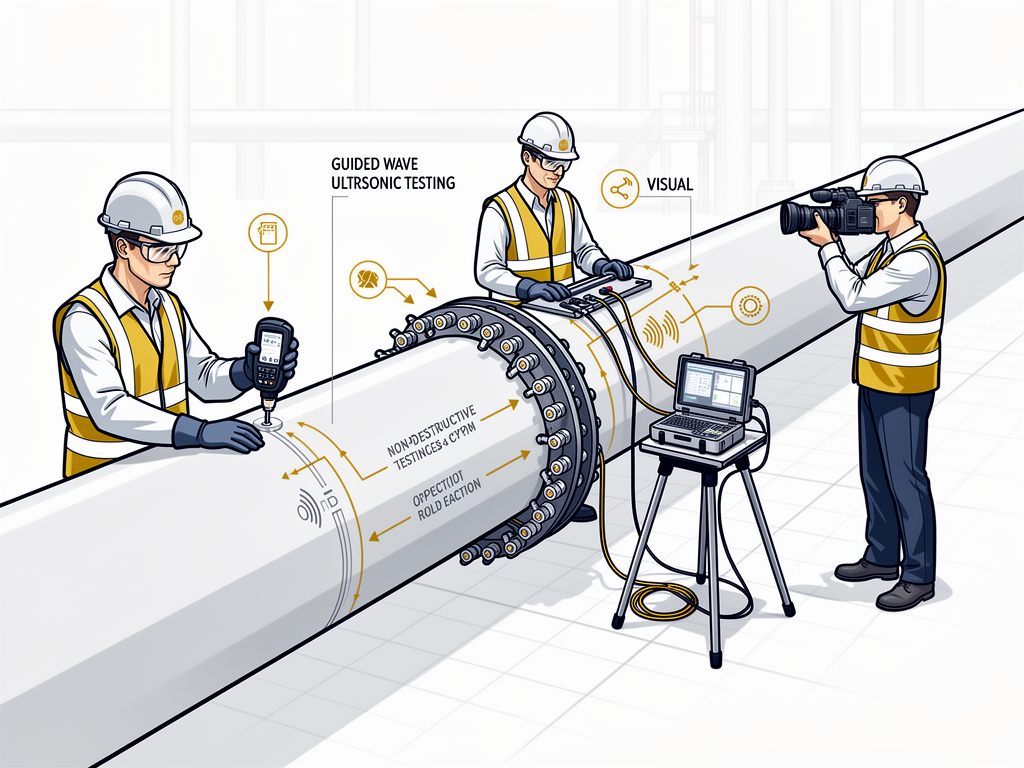
For segments that can be excavated or are otherwise accessible (e.g., at river crossings, road crossings, or above-ground sections), conventional NDT techniques are invaluable. These include:
- Ultrasonic Testing (UT): Wall thickness measurements, flaw detection (shear wave UT for cracks).
- Radiographic Testing (RT): Weld integrity, internal corrosion/erosion.
- Magnetic Particle Inspection (MPI): Surface crack detection on ferromagnetic materials.
- Phased Array Ultrasonic Testing (PAUT): Advanced flaw detection and sizing.
- Guided Wave Ultrasonic Testing (GWUT): Screening for corrosion over longer lengths from a single access point.
Advanced Non-Intrusive Technologies
Emerging technologies offer promising solutions:
- Robotic or Crawler-Based Inspections: Small, tethered or untethered robots equipped with cameras, UT, or other sensors can be deployed in some unpiggable lines, especially larger diameters or short segments. These are often custom-engineered for specific pipeline geometries.
- Flexible Risers/Umbilicals with Sensors: For offshore or complex configurations, flexible risers can be inserted to carry sensors into segments of the pipeline.
- Acoustic Emission (AE) Monitoring: Continuous monitoring for active crack growth or corrosion activity. While not providing direct defect sizing, it can indicate areas of concern.
- Fiber Optic Sensing: Distributed temperature sensing (DTS) and distributed acoustic sensing (DAS) can monitor for leaks, ground movement, and even third-party interference along the pipeline route.
- External Visual and Aerial Surveys: Regular patrols, drone inspections, and satellite imagery can identify surface indications of leaks, ground movement, or third-party activity.
Proactive Mitigation and Remediation
Beyond inspection, integrity management for unpiggable pipelines must emphasize proactive measures to prevent degradation and address identified anomalies.
Coating and Cathodic Protection (CP)
Maintain robust external coatings and a fully functional cathodic protection system. Regular CP surveys (e.g., CIPS, DCVG) are essential to monitor effectiveness and identify areas of coating damage or shield interference. For internal corrosion, consider corrosion inhibitors or chemical treatment programs based on product analysis and flow conditions.
Material Selection and Upgrades
Where feasible and economically justifiable, consider material upgrades or replacement of highly susceptible sections. This is particularly relevant for sections known to be prone to SCC or specific forms of internal corrosion.
Operational Adjustments
Review operating parameters to minimize integrity threats. This could include adjusting flow rates to reduce erosion, optimizing pigging frequency for cleaning (if cleaning pigs can be run), or managing pressure cycles to mitigate fatigue.
Repair Strategies
Develop contingency plans for repairs. This includes having access to suitable repair materials, skilled personnel, and established procedures for excavation, hot tapping, and welding or composite wrap applications. For unpiggable lines, repairs might be more complex due to limited access or the need for specialized isolation techniques.
The Path Forward: A Holistic Approach
Managing the integrity of unpiggable pipelines is not a one-size-fits-all problem. It requires a holistic, risk-informed strategy that integrates data analysis, diverse inspection methods, continuous monitoring, and proactive mitigation. Operators must invest in specialized engineering expertise and leverage available technologies to ensure the continued safe and reliable operation of these critical assets. Regular re-evaluation of the 'unpiggable' status is also prudent, as new technologies or pipeline modifications might eventually enable more comprehensive inspection methods.
Ultimately, the goal is to achieve an equivalent level of integrity assurance for unpiggable pipelines as for those that can be conventionally inspected, albeit through a more intricate and often cost-intensive pathway. This dedication to robust integrity management safeguards assets, protects the environment, and ensures public safety.
Unpiggable Pipeline Integrity Management Workflow

Need support with this topic?
Nonlinear Engineering provides specialist consulting on pipeline integrity, pigging, flow assurance and operations.
Request a consultation →